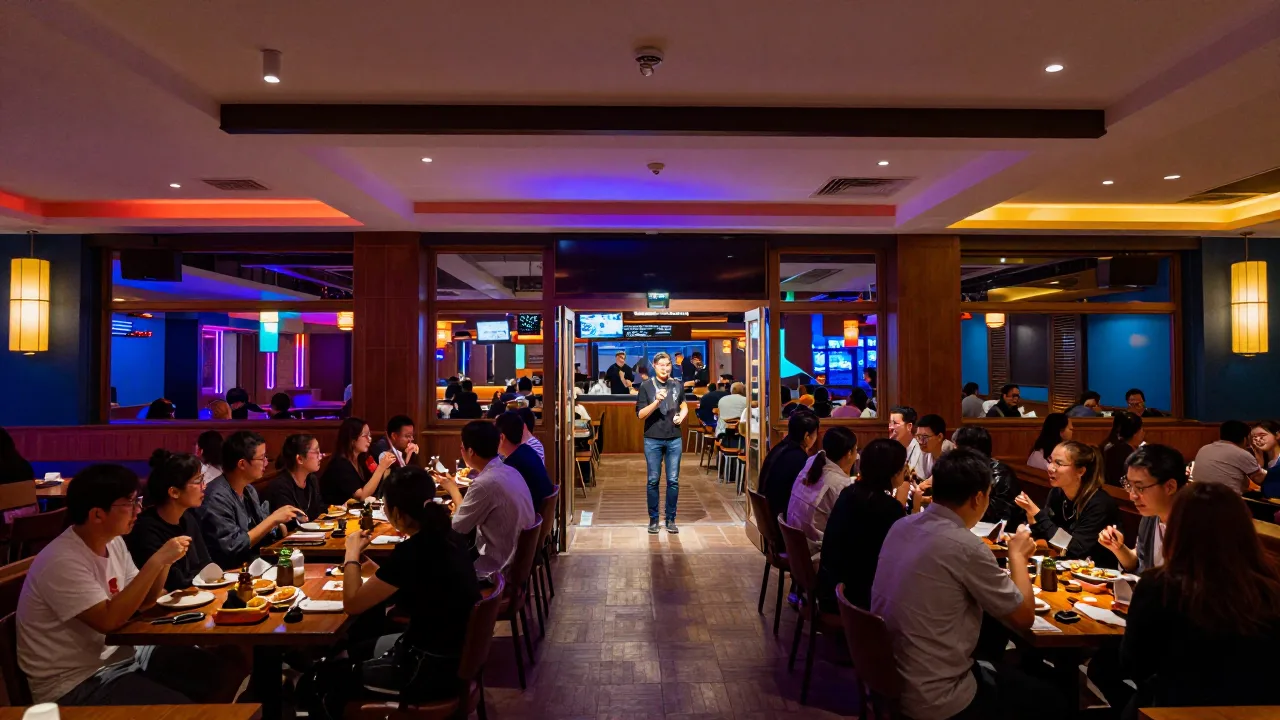
A regional casino property might run 140,000 square feet of gaming floor, six food and beverage outlets, a 1,200-seat theater, and a single pool of guests who move between all of it without ever leaving the building. On a Saturday with a show booked, those six outlets are competing for the same 4,000 people inside a four-hour window — and most of them are trying to manage that with a paging setup designed for a 90-seat restaurant on a street corner.
It does not survive contact. The transmitter at the steakhouse host stand cannot reach the far end of the gaming floor, so guests get paged late or not at all. The buffet and the noodle counter run separate paper lists that no one can see together, so nobody notices the steakhouse is quoting 70 minutes while the noodle bar sits half empty. And every twenty minutes a party that had 8:00 theater tickets walks out of the line because they finally did the arithmetic themselves.
Here is what makes it worse: none of those failures produce a complaint. The guest with the dead pager does not file a report, they go play blackjack and eat later, or not at all. The ticketed party does not tell the host why they left. The revenue simply does not appear, and because it never appears, nobody can point at it. Fixing this starts with accepting that entertainment venues are a genuinely different paging problem — not a bigger restaurant.
Four Ways Venues Break Ordinary Paging
Before evaluating any system, it helps to name precisely what is breaking. Each of these has a different fix, and vendors tend to solve one and stay quiet about the other three.
The Radio Environment Is Hostile
A gaming floor is one of the densest wireless environments in commercial hospitality. Slot telemetry, handheld point-of-sale terminals, security radios, staff headsets, guest phones, and property WiFi all share the air. Low-power coaster pagers on crowded unlicensed bands are the weakest transmitter in that room, and they behave accordingly — intermittent delivery, no confirmation, and no way for a host to tell a dead battery from a lost message.
What makes this specifically dangerous is the silence. A pager that fails gives you no error. The host believes the guest was notified; the guest believes they were forgotten. Text-based paging over carrier networks sidesteps the whole problem because it is not competing for the same spectrum, and it returns a delivery status the host can actually see.
The Building Is Too Big
Practical hardware pager range runs 300 to 1,000 feet in open air and considerably less through structure. A mid-size casino floor exceeds that in one direction, and a multi-level entertainment complex exceeds it in three. You can extend coverage with repeaters, and plenty of properties have, but each repeater is another device to power, mount, and troubleshoot in a space where facilities access is controlled. Venue-scale coverage is exactly the case where the unlimited range of SMS stops being a marketing line and becomes the requirement. The same geometry problem shows up in multi-floor restaurant paging, just at smaller scale.
Guests Are Anchored, Not Waiting
This is the difference nobody outside gaming appreciates. A guest waiting outside a neighborhood bistro is doing nothing else, so they return in three to five minutes. A guest waiting inside a casino is playing, watching a game, or mid-conversation at a bar, and return lag commonly runs 8 to 14 minutes. Design a system around the first number and every table you page sits empty for ten minutes while you wait on the second.
The Clock Is Not Yours
Restaurants inside entertainment venues do not control the guest’s schedule — the show does. An 8:00 curtain means a party needs to be seated by 6:30 and out by 7:45, and a 45-minute quote at 6:50 is not a wait, it is a lost sale that the guest has not realized yet. Any venue paging setup that does not capture event time at the point of joining is flying blind on its single most important constraint.
The Structure That Works: Many Queues, One View
The architectural decision that matters most is deceptively boring. Every outlet keeps its own queue — because a steakhouse turning 95-minute tables and a noodle counter turning 22-minute tables cannot share quote math — but every queue reports into one property-level view.
Why does the single view matter so much? Because it enables the one move that actually grows revenue on a packed night: redistribution. When the steakhouse quotes 70 minutes and the buffet quotes 15, a host looking at both can say "I can seat you in fifteen minutes at the buffet, or I can text you for the steakhouse at 8:15 — your call." Either answer keeps the guest and their money inside the building. Without the shared view, the only available answer is "seventy minutes," and a meaningful share of those guests walk.
Properties that run this well typically see 12 to 20 percent of peak-hour parties accept a redirect to a lower-wait outlet. That is not a rounding error — on a 400-party Saturday, it is 50 to 80 parties that would otherwise have been a shrug and a walkaway. The same principle underpins any shared-crowd operation, which is why the mechanics look a lot like a food hall paging setup, and it is exactly the multi-vendor coordination problem covered in running multiple food court vendors on one system.
Silver Bend Casino Resort — regional property, 1,150 slots
Five outlets: a steakhouse, a buffet, a 24-hour cafe, a noodle bar, and a coffee counter, plus a 900-seat showroom running four nights a week.
Before: the steakhouse and buffet each ran hardware pagers with a repeater apiece; the cafe ran paper. Peak-Saturday pager failure was measured informally at roughly one party in nine, and the F&B director could not produce a wait-time number for the property because no two outlets recorded anything the same way.
After moving to venue-wide text paging with a shared dashboard: outlets kept independent queues, hosts gained a property view, and show times were captured at join. Peak-hour walkaways across all outlets dropped from 13% to 6% over one quarter, redirect acceptance ran 17%, and the showroom stopped fielding complaints about guests arriving mid-first-act.
Key insight: "We thought we had a pager problem. We had a visibility problem. The pagers were just the part we could see failing." — Ray Delacroix, Director of Food & Beverage
Building the Event-Time Guardrail
Of everything in this article, this is the piece most venues skip and most regret. If your property sells tickets, your waitlist needs to know about them.
- Capture show time at join. One optional field at the host stand: "do you have tickets tonight, and for what time?" It takes four seconds and it is the highest-value data point your host collects all night.
- Set the outlet cutoff. For a full-service outlet, stop seating ticketed parties inside 75 to 90 minutes of curtain. For quick-service, 35 to 45 minutes is usually safe. Write the numbers down so the decision is not remade nightly by whoever is on.
- Flag the conflict automatically. If the system quotes a wait that would seat a ticketed party inside their own window, it should warn the host before the quote is spoken aloud, not after.
- Give the guest the honest alternative. "That wait puts you in at 7:20 and you would be rushing. The cafe can seat you now, or I can hold you a table for after the show." A pre-show redirect plus a post-show booking is worth more than one abandoned steakhouse quote.
- Staff the post-show wave. A 900-seat showroom lets out at once. Your paging queue will go from empty to 40 parties in six minutes. Pre-stage hosts and quote conservatively for that first wave.
Handled this way, the curtain stops being a threat and becomes a scheduling input. Venues that run the guardrail consistently report that post-show covers rise noticeably — not because more people show up, but because the parties they used to lose at 6:50 now come back at 9:40.
See Why Restaurants Are Switching to KwickOS
KwickOS runs multi-outlet venues the way they actually operate: an independent queue per restaurant, one property-wide dashboard, text paging with no range limit and no repeaters to maintain, event-time capture with automatic conflict flags, and hold windows tuned for guests who are mid-game rather than standing at the door.
Start Your Free Trial →Tuning for the Anchored Guest
Now for the setting most operators get wrong on day one: hold windows. Copy the defaults from a standalone restaurant and you will burn tables all night.
- Page one table earlier. If your return lag averages 11 minutes, fire the ready text when the party ahead drops their check, not when the busser finishes. You are buying back the lag rather than absorbing it.
- State the hold window in the message. "Your table is ready — we will hold it for 12 minutes" outperforms a bare notification by a wide margin, because it converts a vague nudge into a deadline.
- Never delete silently. A party who does not answer moves to held, not gone. The table goes to the next guest immediately, but the original party stays on screen so the host can reseat them without an argument.
- Brand every message. On a property with six outlets, "your table is ready" is genuinely ambiguous. Lead with the outlet name every time.
- Watch the 2 a.m. shift. A 24-hour cafe has a completely different demand curve than the steakhouse. Let it keep its own quote inputs rather than inheriting property defaults.
Each of these is a five-minute configuration change, and together they are usually worth more than the platform choice itself. The broader case for why guests stop abandoning lines once the wait is explicit and measured is laid out in how paging systems reduce walkaways, and the wider industry shift is well covered in how digital waitlists are changing the dining experience.
The Four Numbers a Venue Should Watch
Venue F&B reporting tends to stop at covers and average check, both of which are outcomes rather than diagnostics. Four operational numbers tell you far more about whether the paging layer is working, and all four come straight out of the waitlist log.
- Message delivery rate. The share of ready notifications confirmed delivered. On a hardware fleet this is unmeasurable, which is precisely the problem. Anything below 97 percent on a text system points at a data-entry issue at the host stand rather than a network one.
- Return lag by outlet. Minutes from notification to check-in, tracked separately per restaurant. A steakhouse pulling guests off the gaming floor will run several minutes longer than a cafe next to the elevators, and each should have its own hold window rather than a property default.
- Redirect acceptance. The percentage of peak-hour parties offered an alternate outlet who take it. If this is under 10 percent, the offer is probably being made badly — hosts need the actual current quote for the other outlet, not a vague "the buffet might be faster."
- Pre-show abandonment. Parties with tickets who join a list and leave before being seated. This is the number that justifies the event-time guardrail, and it should fall to near zero once the cutoff is enforced consistently.
Track those four by outlet and by day, and the property-level conversation stops being anecdotal. A director who can say "we lost 41 ticketed parties last month at the steakhouse between 6:30 and 7:00" has an argument. One who says "the pagers seem unreliable" does not.
What to Ask a Vendor
Venue procurement usually runs on feature checklists, which is how properties end up with systems that demo beautifully and fail on a Saturday. Five questions cut through it:
- Can each outlet hold an independent queue while management sees one combined view — live, not as a nightly report?
- Does the guest need to install anything? On a property with a broad demographic mix, any install requirement costs you a double-digit percentage of guests.
- Can a party be moved between outlet queues without re-entering their information?
- Is loyalty or ticketing lookup a live integration or a file exchange? The answer changes what a host can see at the moment of decision.
- What does the system show the host when a message fails to deliver? "Nothing" is a real answer from some vendors, and it is disqualifying at this scale.
The Bottom Line
Casinos and entertainment venues are not big restaurants. They are several restaurants sharing one crowd, inside a hostile radio environment, on a clock that belongs to a showroom. Paging built for a street-corner bistro fails quietly in all four of those dimensions, and the failures show up as revenue that simply never arrives.
The setup that works is unglamorous: text-based paging that ignores range and interference, an independent queue per outlet, one property view that makes redirection possible, event time captured at the door, and hold windows tuned for guests who are anchored to a machine rather than pacing your lobby. Get those five right and the same crowd you already have starts producing meaningfully more covers — without adding a single seat or a single repeater.